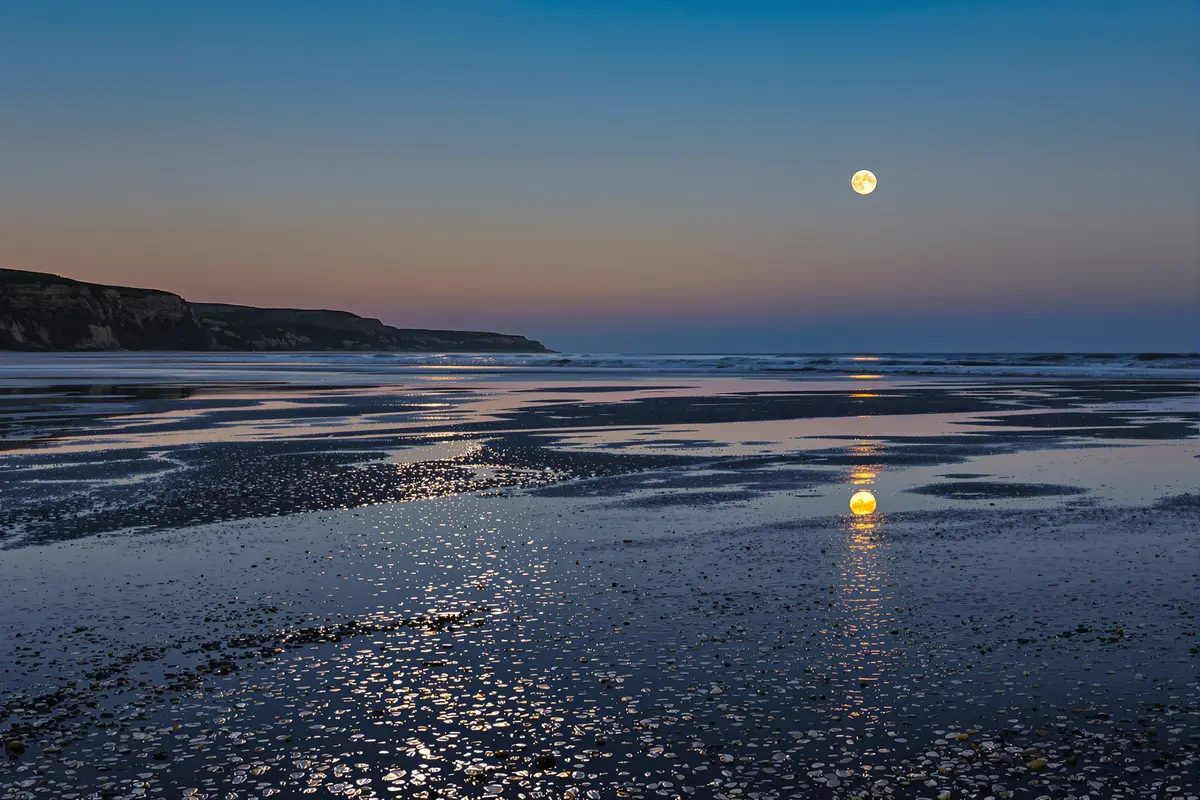
It’s easy to look up at the Moon and assume it’s still and unchanging. But a quiet transformation is taking place—a slow, steady drift that’s reshaping our days, our tides, and even the face of Earth as we know it. You may not notice it from your window, but the Moon is inching away, and the effects are profound.
The Moon is steadily drifting away from Earth
Every year, the Moon moves about 3.8 centimeters farther from Earth. That’s roughly the same rate your fingernails grow. It may sound tiny, but space plays a long game. Over millions of years, that adds up.
Scientists figured this out using something high-tech and surprisingly simple. They fire laser beams at mirrors left behind by Apollo astronauts. By measuring how long the light takes to bounce back, they can tell—exactly—how far the Moon is. And it’s increasing, slowly but steadily.
Why does this matter? Because it’s affecting your day
As the Moon pulls away, Earth’s spin is slowing down. That means days are getting longer, little by little.
Don’t expect a longer lunch break just yet. The effect is tiny on human timescales—fractions of a second over centuries. But it’s real. About 1.4 billion years ago, a day on Earth lasted only 18 hours. Today, we’re at 24 hours, thanks in part to the Moon’s retreat.
What’s behind all this? A slow cosmic tug-of-war
This process is driven by something called tidal friction. Here’s how it works:
- The Moon’s gravity tugs on Earth’s oceans, creating bulges in the water.
- Because Earth rotates faster than the Moon orbits, those bulges are slightly off-center.
- That misalignment pulls on the Moon, giving it a gentle push forward.
- The Moon gains energy and moves to a higher orbit while Earth’s spin slows down a bit.
These tiny energy exchanges repeat constantly, like clockwork, slowly changing the rhythm of our planet.
The tides you feel are changing too
Right now, tides rise and fall thanks mostly to the Moon. But as it drifts away, its gravitational grip weakens. This means tides are slowly becoming less extreme.
In the short term, that change is so small you’d never feel it. But over tens or hundreds of millions of years, coasts could become quieter. Giant tidal surges seen today in places like the Bay of Fundy—where tides swing up to 15 meters—might one day lose their punch.
Softer tides may reshape Earth’s ecosystems
Don’t be fooled into thinking tides are just pretty beach features. They help spread nutrients, shape wetlands, and drive important ocean currents. In the distant past, stronger tides might have helped early life by mixing waters rich in oxygen and food.
As the tides ease, those systems could shift. Shallow coastal areas could build up more sediment. Some wetlands might shrink, while others appear. It may take ages, but life on Earth will adapt to the difference.
How do scientists study such a slow-motion story?
To track the Moon’s drift, scientists use lunar laser ranging, bouncing light off reflectors placed on the Moon’s surface. These measurements can detect movement within a millimeter.
They also look at ancient coral and rock layers, which hold clues to Earth’s rotation. Some fossil corals show more daily rings per year than we see now. That means shorter days and a faster-spinning Earth long ago.
What does this cosmic shift really mean for us?
You won’t feel your morning stretch out tomorrow. But this isn’t just trivia—it’s part of Earth’s deep operating system. The Moon is acting like a cosmic timekeeper. Its motion records our planet’s past and hints at the future.
No, the Moon won’t escape Earth anytime soon. Its drift is slowing, and long before anything dramatic happens, the Sun’s own changes will stir up the cosmic order again.
Small but real changes—and a chance to reflect
The Moon you see overhead tonight isn’t quite the same one your ancestors saw. And it won’t be quite the same for your great-grandkids either. That difference is almost invisible—but undeniably real.
So next time you’re watching the tide or gazing at the Moon, pause for a second. You’re connected to a story that stretches across billions of years. No equations needed—just a bit of wonder and a glance upward.
Key facts at a glance
| Fact | Detail |
|---|---|
| The Moon is drifting away | About 3.8 cm per year, measured by laser ranging |
| Earth’s days are growing longer | By a few milliseconds per century due to tidal friction |
| Tides are slowly weakening | Lunar pull is gentler, reducing tidal extremes over time |
FAQ
- Will the Moon ever completely leave Earth?
Not in any timeframe that affects us. The drift slows over time, and other cosmic factors will change things long before a full departure. - Can we feel the longer days?
No. The difference is only a few milliseconds per century. Only precise instruments can detect it. - Does this affect climate change?
No. Today’s climate is controlled mainly by greenhouse gases. Lunar drift affects long-term ocean patterns, not current warming. - Is the Moon the only source of tides?
Mostly, yes—but the Sun also contributes, and local geography can make a big difference in tidal size. - Has the process always been this slow?
No. It depends on Earth’s ocean layout, land masses, and how energy is lost. It hasn’t been a fixed speed through history.